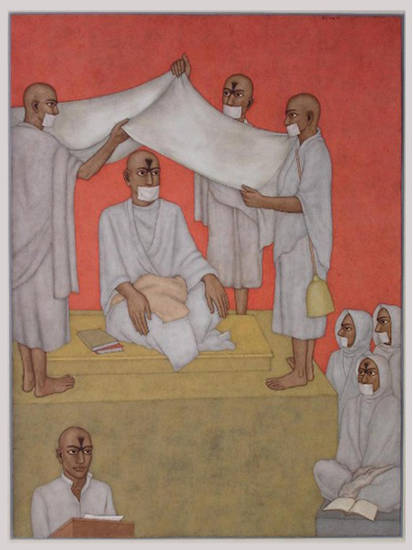
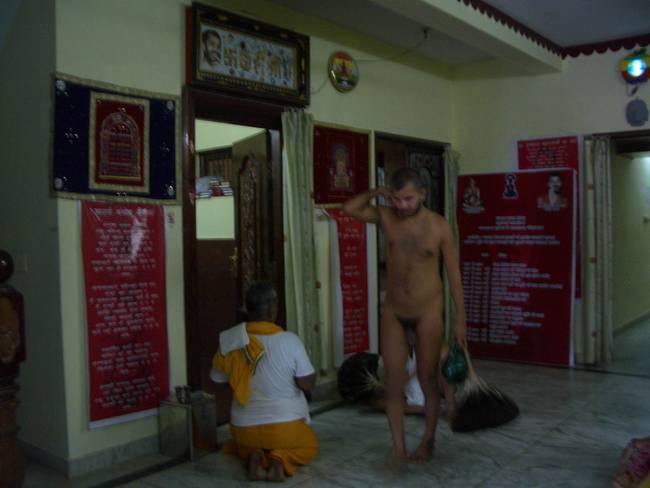
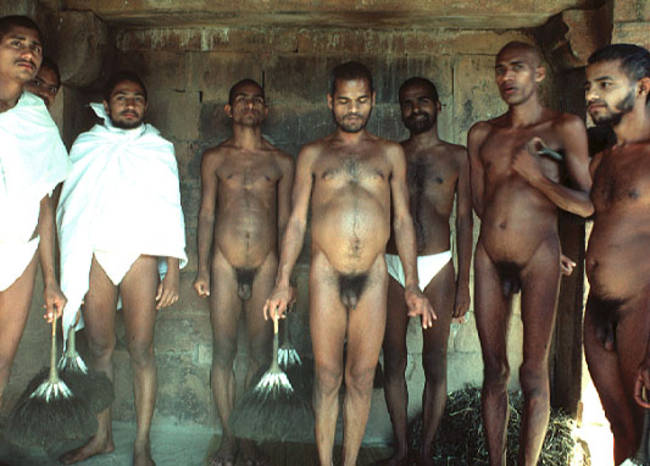
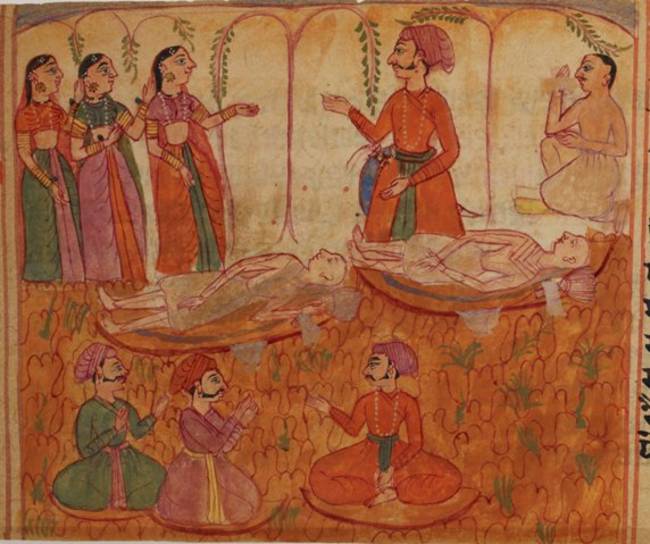
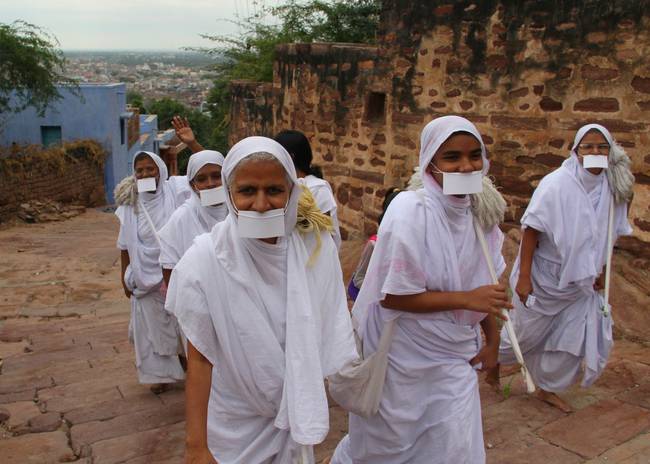
Monks and nuns are frequently referred to as mendicants or ascetics. Jain mendicants are people who have completed the official initiation ceremony called dīkṣā and live according to monastic rules. They renounce ordinary life, receive the monastic equipment in keeping with the monastic order to which they will belong and after that lead a life observing the ‘five great vows’ – mahā-vrata.
Organised in hierarchies, mendicants also follow the rules of their sect and monastic order. Mendicants belong to one of the two main sects of Śvetāmbara and Digambara. They have strict rules regulating their behaviour and monastic equipment.
In contrast to the Christian concept of monks and nuns, Jain ascetics have a wandering lifestyle most of the time and have daily contact with lay people. This chiefly takes the form of the ritual of seeking alms.
There is a range of terms for Jain mendicants, with the Digambaras and Śvetāmbaras normally using slightly different words for the same concepts. An ordinary monk is known as a muni or sādhu while an ordinary nun is an āryikā for Digambaras and is usually called a sādhvī by Śvetāmbaras.
Monks and nuns form two elements of the traditional fourfold community of Jainism, along with lay men and lay women. The proportion of mendicants to lay people is very small. Nuns always outnumber monks in traditional statistics for the communities founded by the Jinas, at least among Śvetāmbaras. For example, according to the Kalpa-sūtra, the fourfold community which the 24th Jina Mahāvīra established was made up of 14,000 monks, 36,000 nuns, 159,000 lay men and 318,000 lay women. There are fewer nuns than monks among the Digambaras.