‘Fundamentals of existence’
Becoming a follower of the Jinas involves accepting and understanding the proper view of reality, which they taught. All other Jain beliefs stem from these seven ‘fundamentals of existence’ – tattvas. These are:
- the sentience of the soul, which is found in many physical forms – jīva
- that some things do not have souls – ajīva
- influx of karma to the soul – āsrava
- binding of karma to the soul – bandha
- stopping the influx of karma – saṃvara
- separating existing karma from the soul – nirjarā
- liberation of the soul – mokṣa.
The seven tattvas are described in the Tattvārtha-sūtra, the key statement of Jain principles that is accepted as the basic religious text by all Jain sects.
Two more tattvas are often added, namely:
These nine principles are analysed in detail in the Navatattva-prakaraṇas. Available in shorter and longer recensions, these are among the works that form the basis of the monastic curriculum.
Soul
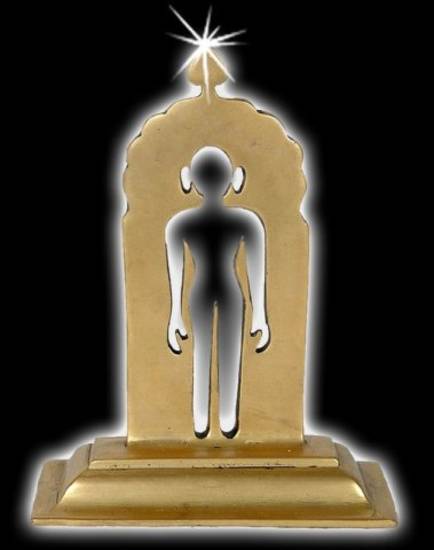
Image of a siddha
Image by Hindi Granth Karyala © Public domain
The Jain faith revolves around the notion of the soul – jīva. The ultimate objective of the Jain religion is for the soul to attain self-realisation, which is liberation.
The soul is a concept found in many religions but Jain beliefs about the soul or self are very distinctive. In Jain cosmology the soul is a pure substance with:
- consciousness – caitanya
- energy – vīrya
- bliss – sukha.
The soul always has these qualities – guṇas – and others, regardless of the body it inhabits.
Souls are found within many types of living beings, ranging from those with one sense to those with five. A soul contracts or expands to fill the available space inside a body, from a tiny, one-celled nigoda to a five-sensed blue whale.
The soul is a non-material substance – dravya – and there are infinite numbers of individual souls. They are all bound in the cycle of rebirth – saṃsāra – by the karma generated by the bodies within which they exist, until they are liberated from flesh and ascend to the siddha-śilā. There, at the top of the universe, all the siddhas – liberated, disembodied, perfect souls – exist in permanent bliss.
The opposite of jīva is ajīva, which can be described as the absence of soul. Ajīva is found in non-living things. Both forms of matter make up the universe, according to Jain cosmology.
Karma
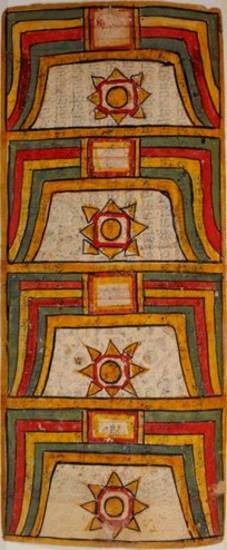
Structure of four hells
Image by British Library © CC0 1.0 (Creative Commons Public Domain)
Another key Jain belief is karma. The soul is trapped in the cycle of rebirth – saṃsāra – by karma. In the cycle of births, the soul – jīva – is born into many different types of body – kāya – each with attachments to its world, including passions or emotions. Thoughts, speech and action create different types of karman or karma, which are bound to the soul, weighing it down and obscuring its shining brightness. To regain its original pure condition, the soul must rid itself of karma by progressing spiritually.
The concept of karma is found in other religions that originated in the Indian subcontinent, such as Buddhism and Hinduism. However, the Jain notion of karma is unique, as it is considered a physical material that gets stuck to the soul. It is a type of pudgala – highly subtle matter – that is insentient.
Karma is a highly complex notion for Jains, with 148 kinds grouped into eight main categories – the mūla-prakṛtis – each of which has different effects. These eight categories are classified into the uttara-prakṛtis. Each type of karma is defined by elements, such as duration, intensity and quantity, and presents different aspects.
The various types of karma influence different elements of a birth and future births. For example the lifespan of a living being is determined by its āyus-karma.
‘Scales of perfection’
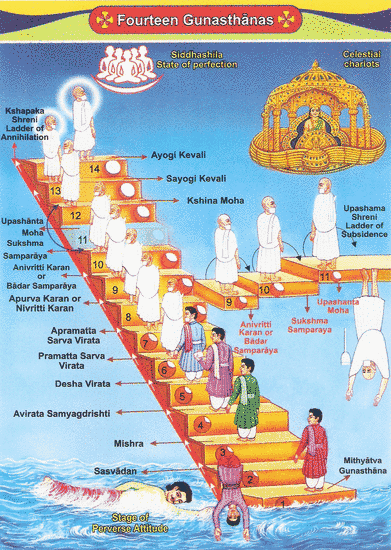
Fourteen guṇa-sthānas
Image by Shree Diwakar Prakashan © public domain
The ‘scale of perfection’ – guṇa-sthāna – is a way of guiding human beings gradually towards liberation. As people follow the beliefs and practices associated with each of the 14 successive stages, they advance spiritually.
To advance to the sixth stage, Jains must become mendicants. The gulf between the lay and mendicant lifestyle is so big that there is another step-by-step framework to help lay people become monks or nuns. The 11 levels of the pratimā enable lay Jains to live more like mendicants in stages, although they can decide not to progress further.
As it travels up the ‘scale of perfection’, the soul reaches levels of spiritual development where it destroys its bound karma and stops new karma from sticking to it. It can thus attain, in stages, absolute knowledge – kevala-jñāna – and finally liberation, which means the soul is freed of all karma and is perfected once again. Spiritual development requires that the human within which the soul is embodied for this lifetime accepts Jain principles and undertakes practices that reduce karma.
Leśyā
A soul’s level of spiritual development can be gauged by its leśyā. This is a staining of the soul a certain colour. The soul‘s leśyā takes various colours, with certain colours indicating spiritual level.
A perfect soul has no karmas, so its inherent purity and clarity can be seen. As a soul develops spiritually, it gets lighter and brighter.
Knowledge
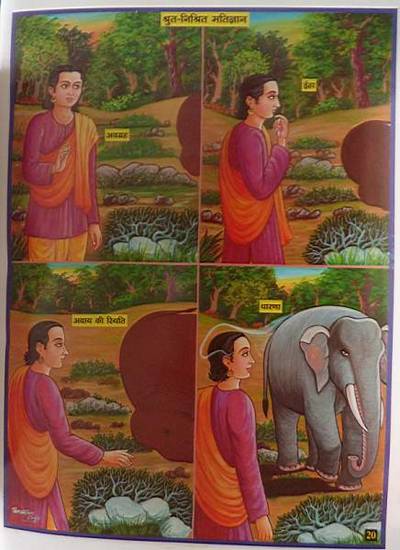
Stages of knowledge
Image by Diwakar Prakashan / Padma Prakashan © Diwakar Prakashan / Padma Prakashan
There are five types of knowledge – jñāna – in traditional Jain thought, namely:
- mind-based and sensory knowledge – mati-jñāna
- scriptural knowledge – śruta-jñāna
- extra-sensory knowledge or clairvoyance – avadhi-jñāna
- knowledge of others’ minds or telepathy – manaḥparyāya-jñāna
- omniscience or absolute knowledge – kevala-jñāna.
Knowledge is a fundamental element of the quest for spiritual progress. As a soul develops spiritually, freeing itself of karma, it acquires greater knowledge, until it accomplishes perfect knowledge – kevala-jñāna. This is achieved solely at the highest spiritual levels, shortly before final emancipation – mokṣa.
Thus a soul can gain the different types of knowledge with spiritual progress. But knowledge is also a way to advance spiritually, because the correct view of reality is the first, basic step in spiritual progression. Accepting the teachings of the Jinas is the first of the three jewels while the second is ‘correct knowledge’ or ‘proper knowledge’ – samyag-jñāna. It means grasping properly the fundamental truths, as revealed by the Jinas.
Omniscience
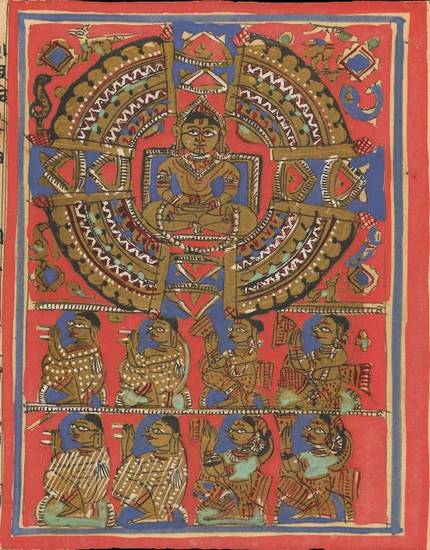
Universal gathering and fourfold community
Image by British Library © CC0 1.0 (Creative Commons Public Domain)
Absolute knowledge – kevala-jñāna – is omniscience or enlightenment and is a prerequisite to achieving liberation. Absolute or perfect knowledge is the highest of the five different types. An omniscient person knows everything that ever happened, is happening or will happen in all parts of the universe.
The hardest type of knowledge to achieve, enlightenment occurs in the 13th stage of spiritual purity in the guṇa-sthāna. All karma is destroyed when reaching omniscience so an omniscient individual becomes liberated – mokṣa – on death.
Someone who is enlightened is called a kevalin. All Jinas attain omniscience before reaching mokṣa but not all kevalins are Jinas. Kevalins do not teach others whereas each Jina founds a fourfold community of lay men, lay women, monks and nuns, and preaches the way to achieve salvation.
Digambaras believe that only men can attain omniscience but Śvetāmbaras believe that both men and women can become enlightened.
Liberation

Home of liberated souls
Image by British Library © CC0 1.0 (Creative Commons Public Domain)
Liberation means the freeing of the soul from the cycle of birth – mokṣa – so it regains its original purity. On the death of the body in which it dwells, instead of being born into another body the liberated soul – siddha – flies up to the siddha-śilā. At the apex of the universe, this is where all the liberated souls exist as separate perfect beings in permanent ecstasy.
When it experiences mokṣa the soul is liberated from flesh and is perfected. Emancipation is also known as nirvāṇa. This is the ultimate goal of the Jain religion.
Humans are the only beings that can be liberated but not all humans are considered capable of reaching emancipation. Only perfect mendicants can develop spiritually enough to reach salvation because they achieve complete detachment, which reduces karma. Such detachment is impossible for lay people, who must live in the world and take part in life in the family and community, to varying degrees. This is why only mendicants, who leave behind the householder life, can move towards liberation.
The question of whether women can attain mokṣa is answered differently in the various Jain sects. The Digambara tradition holds that women cannot reach emancipation because they can never achieve the total detachment that is necessary. In contrast, the Śvetāmbara sects assert that women can accomplish salvation.
Cycle of birth
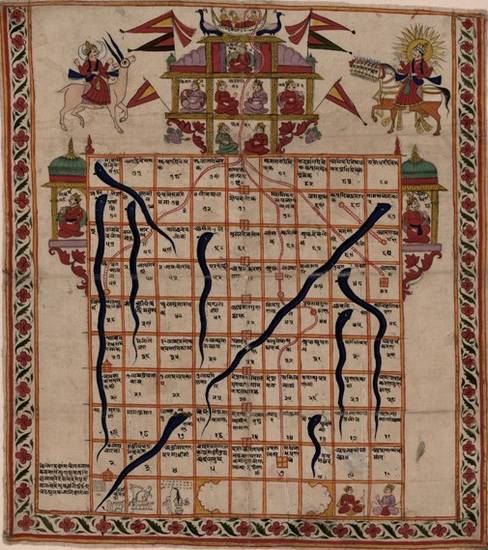
Snakes and ladders
Image by Victoria and Albert Museum © V&A Images/Victoria and Albert Museum, London
One of the principal Jain beliefs is that an unliberated soul exists within the physical form of one body, dies and is then born in another life and body. This process continues until the soul has rid itself of all karma. Only then is it liberated from the cycle of births – saṃsāra – which is often referred to as the ocean of rebirth. Jinas are often described as Tīrthaṃkaras or ford-makers, who cross the ocean of rebirth to liberation – mokṣa – and create a ford for others to follow them.
The body and life into which a soul is born vary depending on the karma it has accumulated in previous lives. Only those souls that reduce their karma by practising austerities – tapas – can develop spiritually enough to progress up the scale of perfection – guṇa-sthāna. Over many many lifetimes, souls gradually reach the top of the scale and are then liberated from the cycle of rebirth.
Behaving badly – meaning, against Jain principles – in one birth means that certain karmas become attached to the soul and result in rebirth in a non-human body. Then it is more difficult to gain karmas that enable rebirth in a human body. This is vital for liberation because, out of all the types of living beings in the Jain universe, only human beings can be liberated.
A soul is usually reborn countless times in different lifetimes, sometimes developing spiritually, sometimes deteriorating spiritually. Spiritual progress is not normally a straightforward process, demonstrated in the Jain game of gyanbazi, which is similar to the Western game of snakes and ladders.
Types of bodies
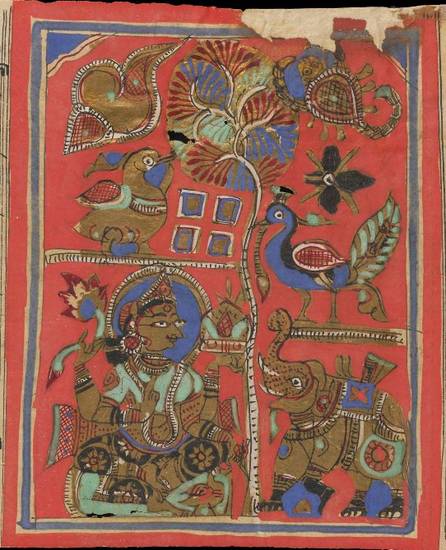
Examples of types of living beings
Image by British Library © CC0 1.0 (Creative Commons Public Domain)
During its time in the cycle of birth, the soul is reborn in different conditions depending on the karma gathered in various lifetimes. There are four conditions or mode of rebirth – gatis:
- human being – manuṣya-gati
- god or heavenly being – deva-gati
- animal or plant – tiryag-gati
- infernal being – naraka-gati.
Living beings are also classified by the number of senses they have. The single sense of touch is the most basic and is found in the simplest form of life – nigoda – and other beings that exist in elements such as fire, water, air and earth. Human beings, gods and hellish beings have five senses
The more advanced a soul’s spirituality, the more senses its body has during this birth or lifetime.
Non-violence
The most important Jain principle is ahiṃsā. Usually translated into English as ‘non-violence’, ahiṃsā is thus often understood as ‘doing no deliberate violence’. A more accurate translation of the Jain concept might be:
- ‘doing no harm, whether deliberate or accidental’
- trying to actively achieve whatever is required to protect living beings by restraining oneself.
It underlies the other principal beliefs and is the foundation of Jain religious practices. The vows of Jain mendicants and lay people are based on ahiṃsā, which forms the first of the five ‘fundamental vows’.
Jains must take care to avoid violent thoughts, speech or behaviour. Harming other living beings, even accidentally, creates karma that attaches to the soul, obscuring its purity and hindering its liberation. Avoiding injury to all living beings, which are all interconnected, is therefore vital to spiritual development. Deliberate violence is the worst kind but carelessness can also damage or kill living beings. This explains why carefulness and self-awareness are two of the key elements of being a perfect lay Jain or ideal mendicant, since these qualities minimise accidental violence.
Detachment
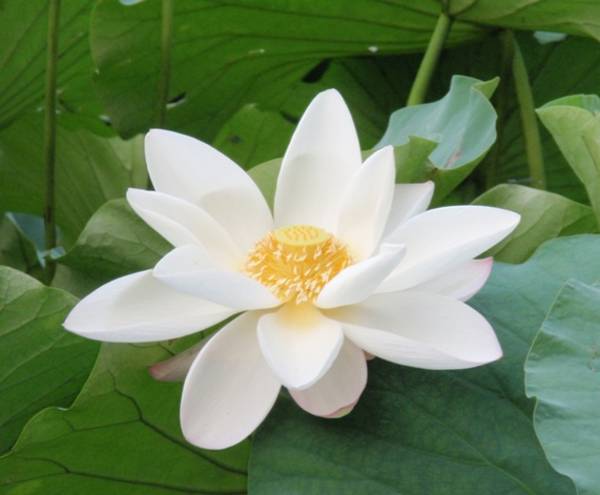
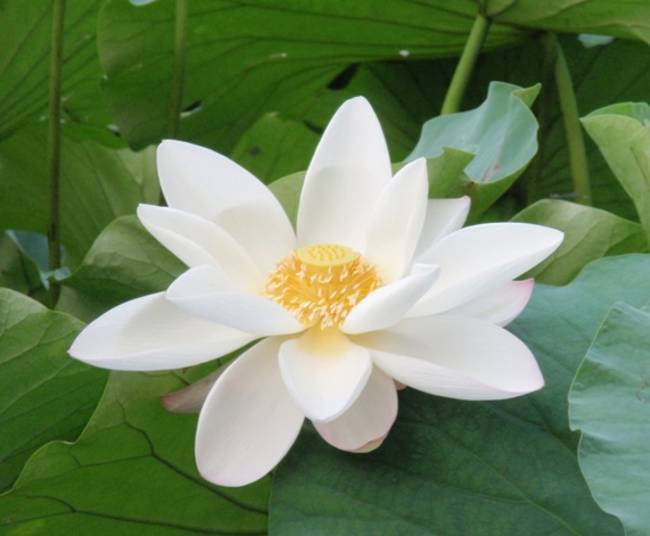
White lotus
Image by Haha169 © public domain
This is an important aim in practising the Jain faith because karma is generated by passions – kaṣāyas – or emotions, among other things. Being in a permanently calm condition free from passions, and thus karma, is a crucial stage in spiritual development. Passions are created by attachment to the world so spiritual progress requires utter detachment from the world.
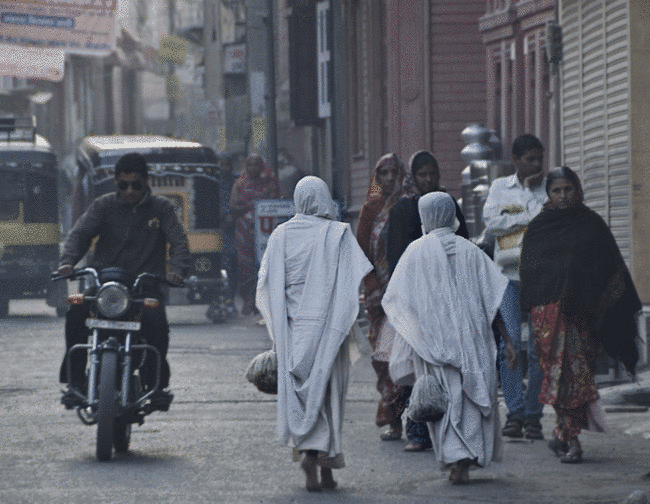
When Jains renounce the lay condition to become monks and nuns, they detach themselves from all aspects of life in the world. This includes family relationships and concern for the physical body, such as tasty food, desire for warmth, comfort and personal cleanliness and the instinct to avoid or stop pain.
Jains who remain householders cannot achieve this level of detachment because they have duties to family and community. But they can work within these limits to progress spiritually. For example, they can attempt to avoid developing feelings of attachment to material things. The fifth aṇu-vrata formalises the idea of setting limits on material possessions, so that lay Jains can practise a degree of detachment.