Lands of Action
Cyclical time is found only in some areas of the central continent of Jambū-dvīpa of Jain cosmology.
Jambū-dvīpa has several regions. In the Lands of Enjoyment people do not need to make any effort and can enjoy life. Here there is no cycle of time. However, in the Lands of Action, where human beings live and where they suffer and must work to live, time forms a repeating cycle.
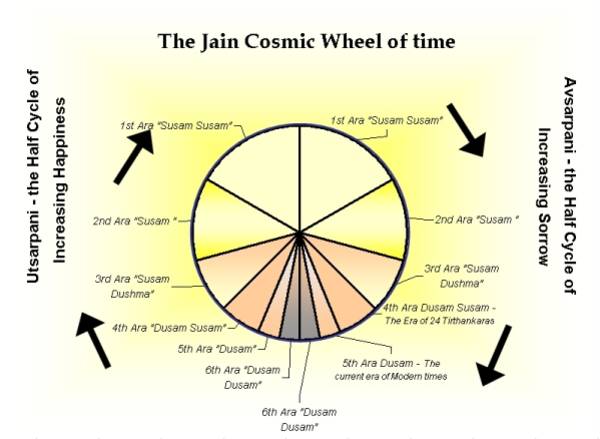
Here a single cycle or kalpa is made up of two equal phases. Each phase or half-cycle has six periods of time, which vary in length. Each phase follows another without a break.
Cycle of time
Cycle of time
Image by Anishshah19 © public domain
The cycle of time is traditionally represented as a wheel with 12 spokes, known as the Kālacakra. In the first phase – of six half-cycles – the quality of life gradually deteriorates while in the second one it slowly improves over the six periods.
In traditional Jain cosmology, time is endless and for humans is an unbroken sequence of cycles of time. Each cycle or kalpa is made up of two half-cycles or phases. Each half-cycle has six periods, lasting different lengths of time. Each of these periods of time is enormously long, far longer than a human lifetime, but has a fixed length.
In the first phase – of six half-cycles – the quality of life slowly worsens while in the second one it gradually gets better over the six periods. A full cycle of time therefore has 12 periods of time in total, half of them deteriorating, half of them improving.
The ‘Descending Phase’
The Sanskrit term for ‘descending phase’ is avasarpiṇi. Also called the ‘regressive half-cycle’, it sees the gradual worsening of conditions over the six eras. Life gradually declines in terms of knowledge, lifespan, stature, pleasure, morality and spirituality. In this phase, the conditions begin at ‘extremely happy’ and get worse over the course of the epochs until they end at ‘extremely unhappy’.
|
English description |
Sanskrit |
Duration |
|---|---|---|
|
extremely happy |
4 crore of crore of sāgaropama |
|
|
happy |
3 crore of crore of sāgaropama |
|
|
more happy than unhappy |
2 crore of crore of sāgaropama |
|
|
more unhappy than happy |
1 crore of crore of sāgaropama |
|
|
unhappy |
21,000 years |
|
|
extremely unhappy |
21,000 years |
In traditional Jain cosmology, time is endless and for humans is an unbroken sequence of cycles of time. Each cycle or kalpa is made up of two half-cycles or phases. Each half-cycle has six periods, lasting different lengths of time. Each of these periods of time is enormously long, far longer than a human lifetime, but has a fixed length.
In the first phase – of six half-cycles – the quality of life gradually declines while in the second one conditions steadily rise over the six periods. A full cycle of time therefore has 12 periods of time in total, half of them deteriorating, half of them improving.
The ‘Ascending Phase’
The Sanskrit term for ‘ascending phase’ is utsarpiṇi. Also called the ‘progressive half-cycle’, it sees the gradual improvement of conditions over the six epochs. Life gradually gets better in terms of knowledge, lifespan, stature, pleasure, morality and spirituality. In this phase, the conditions begin at ‘extremely unhappy’ and are enhanced over the course of the eras until they end at ‘extremely happy’.
|
English description |
Sanskrit term |
Duration |
|---|---|---|
|
extremely unhappy |
21,000 years |
|
|
unhappy |
21,000 years |
|
|
more unhappy than happy |
1 crore of crore of sāgaropama |
|
|
more happy than unhappy |
2 crore of crore of sāgaropama |
|
|
happy |
3 crore of crore of sāgaropama |
|
|
extremely happy |
4 crore of crore of sāgaropama |
Each kalpa or cycle of time has two halves, each of six periods. One half-cycle is the ‘ascending phase’ – utsarpiṇi – while the other half is avarsarpiṇi or the ‘descending phase’.
Liberation
Perfect beings and paths to liberation
Image by British Library © CC0 1.0 (Creative Commons Public Domain)
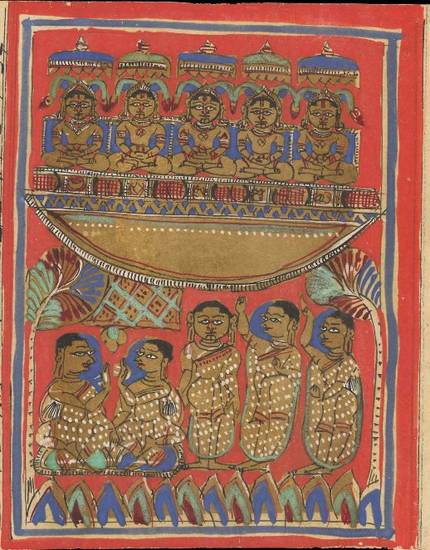
Liberation from the cycle of rebirth is only possible in the third and fourth epochs of each phase.
|
English description |
Sanskrit term |
|---|---|
|
more unhappy than happy |
duṣamā-suṣamā |
|
more happy than unhappy |
suṣamā-duṣamā |
The current age is the fifth or unhappy stage – duṣamā – of a regressive cycle. It began soon after the death of Māhavīra, the 24th and final Jina of this era. Therefore human beings born in this stage cannot reach liberation.